

Email personalisation, and the benefits that come with it, isn’t new. What’s changed is access to AI, machine learning and predictive analytics. Brands of all sizes can now build more responsive journeys, using what they already know about their audience.
“A personalised email journey could be something as simple as including the customer’s name in the email salutation or subject line, but a hyper-personalised email journey will be more than that,” explains Vicki Sherman, Dialogue’s Digital Production Lead. “It should be a journey built on what the brand knows about the customer. In the automotive sector, for example, it could be content linked to the specific vehicle model they own, how they use that vehicle, or other interests that are relevant to them.”
For senior marketing leaders, this isn’t about novelty. It’s about commercial resilience. In categories where brand preference is fragile and switching is easy, relevance is a growth lever. When it’s done with care, hyper-personalisation can lift engagement and conversion and strengthen brand affinity over time.
Using information such as browsing history, purchases and contextual factors, brands can deliver behaviour-based, highly relevant messaging in their emails to optimise engagement and boost conversion rates more effectively than basic personalisation.
The need for personalisation (and why ‘more’ isn’t always better)
Most brands understand the value of personalisation in email. Hyper personalisation takes this further, shifting the focus from broad segments to individual context and intent.
The best email experiences feel less like messaging and more like service: timely, useful and considerate. That matters across Dialogue’s specialist sectors:
- Luxury, travel and hospitality: pre-arrival upsell, in-stay service touchpoints and post-stay re engagement that reflect guest preferences, delivered with discretion.
- Automotive: message around the ownership lifecycle, from handover to servicing, accessories and upgrades, so comms feel like useful ownership support rather than sales pressure.
- Membership and brand communities: tailor onboarding, benefit discovery and renewal journeys, and recommend events and content that match how members take part.
- Local: use proximity and local context, such as opening hours, local events and availability, to send fewer messages that drive visits and bookings.
Hyper-personalisation goes beyond name, location, age, gender and other demographic segmentation. It’s driven by signals that help you answer a simple question: Is this message genuinely useful to this person, right now?
Where to utilise hyper-personalisation
1) Real-time context (relevance at the moment of open)
Content changes based on the moment someone opens the email. That might be stock levels for a product they’ve shown interest in, or a travel brand recommending a sunny destination to users opening the email from somewhere currently rainy. For premium brands, the aim is subtlety. The email feels well-timed, not overly familiar.
2) Behaviour-triggered journeys (service, not schedule)
Instead of sending to a fixed timetable, messages are triggered by actions, such as an abandoned basket, a return visit to a key page, or engagement with a previous email. For leadership teams, the benefit is simple: fewer wasted sends, more relevance and a clearer measurement story, because each message has a defined job.
3) Individualisation (recommendations that reflect intent)
Recommendations are shaped by what someone has done before. In automotive, that could reflect ownership stage, model-specific interests or experience preferences. In membership, it can cover benefits or events linked to what members have already shown they value.
4) AI prediction (what to send next, at scale)
Machine-learning models can help you decide what a person should see next, for example the next piece of content, product recommendation, offer, or even the best time to send. That means messaging can adapt without teams building endless variations by hand. According to AI Bees, businesses that have integrated AI into their email marketing strategies have noticed a spike in click-through rates of 41% and an increase in conversion rates of 20%.
Bringing it to life through journeys, content and operations
“With any brand, there’s a desire to give customers and members something that adds value. These comms shouldn’t be one-size-fits-all. On the technical side, the customer journey can be designed so content is hyper-personalised and it should tell a story that resonates with the individual,” says Vicki.
This is where strategy meets delivery. The strongest programmes combine smart segmentation, good automation and well-built templates, so personalisation remains consistent across markets and languages.
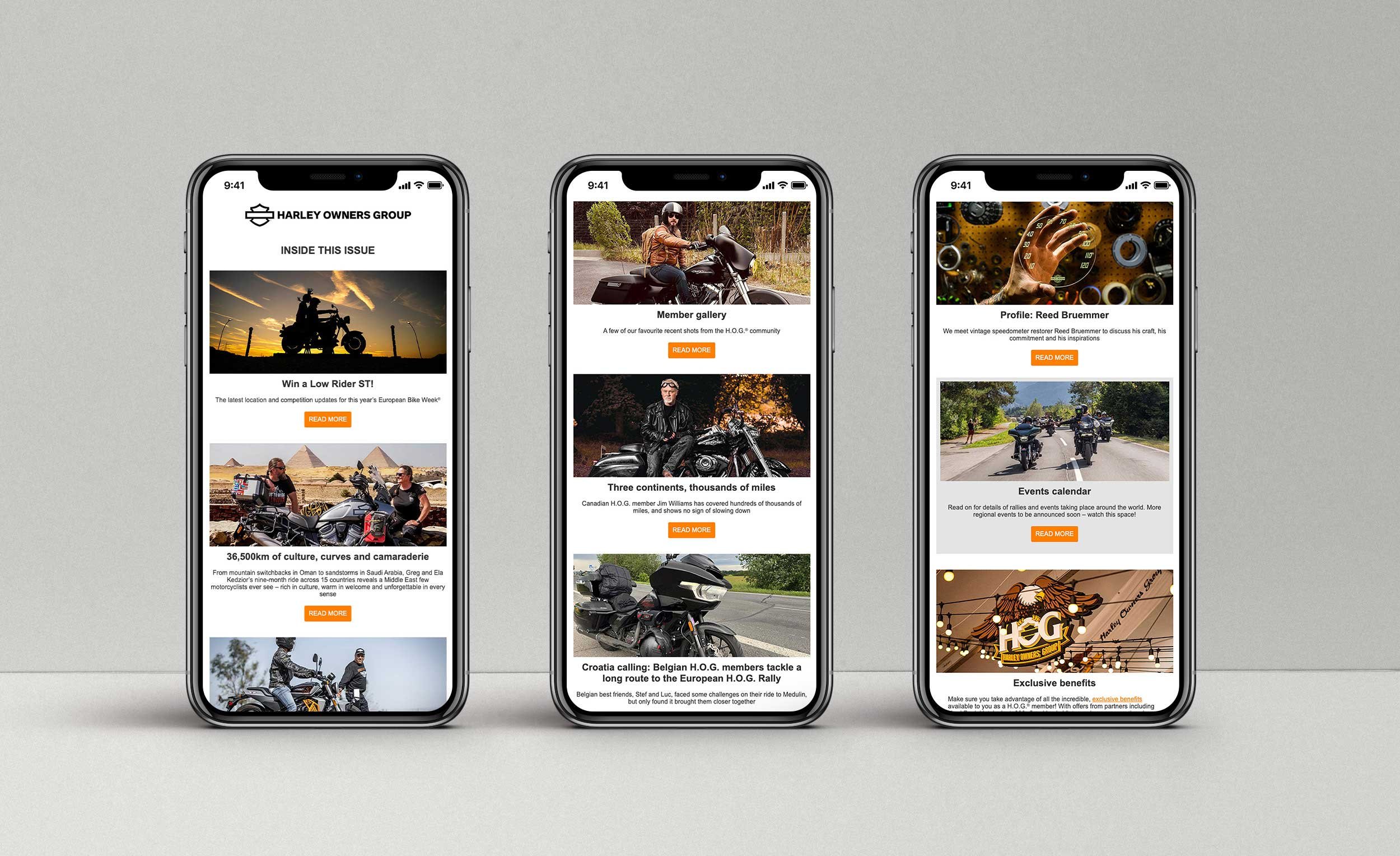
Dialogue’s work for Harley Owners Group (H.O.G.) involves producing monthly segmented and automated content-rich emails in multiple languages, plus bespoke emails for specific regions and nations, where hyper-personalisation is key to remaining relevant.
Case study: Harley Owners Group (H.O.G.), hyper-personalisation at global scale
Dialogue supports Harley-Davidson’s Harley Owners Group (H.O.G.), the world’s largest manufacturer-sponsored motorcycle club, with email and CRM delivery built for relevance at scale. Our work spans monthly content-led newsletters alongside automated membership journeys, including renewals, plus bespoke comms for regions and nations. That means members receive messaging that fits their context, language and relationship with the brand. We work across multiple markets, bringing creative, data and delivery together so the experience feels consistent, premium and genuinely useful. The result is highly engaged member communications, with opening rates consistently above 50%.
Our approach: hyper-personalisation that works
Hyper personalisation works best when it’s rooted in intent. That means being clear on the goal first, then designing the strategy to reach it.
“I will start by asking is there anything that we can add in that will make it more special and unique? Is there anything we can simplify that’s perhaps over-engineered that’ll get the same result? Should we be building anything with future plans in mind? Once we have a good understanding, then we can look at the creative, audience data and even the email service provider to see if it has the capabilities to fit what is intended,” outlines Vicki. “The journey must be logical and offer something of value based on the desired outcome. And the emails themselves must be both beautifully designed and functional. I’m a big fan of the Steve Jobs mantra ‘Design is not just what it looks and feels like. Design is how it works.’”
For senior stakeholders, we typically structure the work around four executive safeguards:
- Value exchange: what does the audience get (time saved, clarity, reassurance, access, inspiration)?
- Signal quality: are we personalising based on meaningful signals, or on shallow data that can feel creepy or just get it wrong?
- Governance and compliance: what data are we using, how are we using it and how do we stay on the right side of trust?
- Operational scalability: can the approach scale across regions, languages, property portfolios or model lines without becoming a content bottleneck?
Establishing KPIs, setting benchmarks and A/B testing at the outset are key to monitoring success. Once live, we use tracking and insight to constantly analyse, test and evolve, summarises Vicki. You can read more about how to evaluate the success of your email marketing strategy.
For C-suite stakeholders, the most useful scorecard links personalisation back to commercial outcomes, not just email engagement. Depending on your sector and data maturity, that might include:
- Incremental revenue: bookings, upgrades, repeat purchase, basket size.
- Retention: renewal rate, churn reduction, reactivation, customer lifetime value (LTV).
- Efficiency: cost-to-serve and production time reduced through modular content and automation.
- Pipeline influence: enquiries, test-drive bookings, service appointments, qualified leads (where relevant).
Hard metrics matter but so do softer measures such as awareness, recognition, loyalty and advocacy. Hyper-personalisation can help because it positions your brand as helpful, rather than pushy.
Where it goes wrong
AI can help you understand customers by analysing behaviour patterns in real time and adjusting content, timing and offers based on each recipient’s preferences. Emails can adapt based on browsing history, purchase behaviour, engagement patterns, location, device and likely open time. With dynamic templates, recommendations, imagery and messaging can swap by journey stage or loyalty status, which often reduces the need for lots of manual versions.
But brands also need to avoid over-personalisation. If an email references every click or unusually specific behaviour, it can feel invasive and over-familiar, which can lead to unsubscribes or complaints rather than engagement.
Hyper personalisation depends on using richer data signals, but that comes with responsibility. The more detailed the insight, the higher the expectation that it will be handled with care. For premium brands in particular, discretion is not optional. Misjudged use of data doesn’t just undermine engagement, it can damage trust and reputation.
That’s why governance has to be designed in from the start. In practice, this means working closely with legal and data teams to ensure approaches align with GDPR, alongside the UK’s marketing and cookie rules such as PECR, and ePrivacy requirements across the EU. For US and other markets, we apply the same privacy first principles, adapting to local regulation. Clear consent, robust preference management and disciplined data use are essential, using only what’s needed for a defined purpose, being transparent about how it’s used, and setting sensible limits so relevance never comes at the cost of trust.
Brands mastering hyper-personalisation (without making it feel like marketing)
- Spotify: an early example of hyper-personalisation at scale. Spotify Wrapped emails use behavioural data to recap a user’s listening habits in a highly shareable format.
- Sephora: its Beauty Advisor emails use data on concerns and purchase history to send tailored recommendations and offers, with content shaped further by loyalty tier.
- Amazon: using large data sets, Amazon’s recommendations predict buying behaviour and support highly personalised emails.
The bigger picture: why hyper-personalisation is really a storytelling discipline
Effective content marketing comes from people who really understand your brand. They know your product, service or membership model well enough to tell stories that feel true, informed and useful.
The same is true for hyper-personalised email journeys. Understanding how you and your customers interact helps craft journeys that make sense and get results.
Looking ahead, a hybrid approach tends to work best. AI can handle data and dynamic delivery, while humans set the strategy, decide the boundaries and keep the experience feeling human.
“If done well, hyper-personalisation moves us away from ‘targeted marketing’ and towards truly responsive experiences, where content feels less like a campaign and more like a conversation,” explains Vicki. “The brands that get this right will create journeys that feel intuitive rather than intrusive, because they’re built on meaningful signals, not assumptions.”
Want to explore what hyper-personalisation could look like for your brand?
If you’re a CMO, Marketing Director or Commercial leader looking to improve email performance without increasing production complexity and without compromising brand discretion, we can help.
Dialogue designs email journeys that balance data, design and human judgement, so your communications feel personal, premium and purposeful at scale. Read more about our approach to email, CRM and automation.
Talk to us about designing hyper personalised email journeys that balance relevance, performance and trust.

Resources
Businesses that have integrated AI into their email marketing strategies - AI Bees

Read more insightful articles
See more from the blog Content
Beyond the click – are we measuring email too narrowly?
 Content
Dialogue shortlisted for 10 International Content Marketing Awards 2026
 Automotive
Tactical gravity: why automotive launches can drift away from strategy
 Content
The guest confidence gap: when discovery isn’t enough
Proud to be a winner of industry awards, recognised as content marketing experts in print and digital media.