-
Content Marketing For
Luxury Audiences >

-
Trusted By
Leading Automotive Brands >
-
Experts In
Travel & Hospitality >

Lots of people talk about ‘brand storytelling’ and ‘story-driven marketing’. But it is rare to see good examples of it. This is probably because most people don’t really understand exactly what a story actually is – let alone how to make it drive commercial actions.
We know a story when we hear one or watch one, but, like cars, just because you can recognise one, doesn’t mean you can make one. And that matters, because storytelling is not just a brand ideal, a creative flourish or a nice extra to layer over a campaign once the ‘real’ work is done. It is one of the best ways to make people care, understand, remember and act – that’s the commercial case.
In an AI-saturated market, where content is easier to produce than ever, the real differentiator is not volume, speed or even competence, it’s whether you can make people feel the stakes, follow the movement and picture the change. And of course, act because of it.
In other words: can you tell an actual story?

Most ‘brand storytelling’ is not actually a story
A lot of so-called storytelling is really just description, messaging or a brand talking about itself in a slightly more polished tone of voice and then calling that a narrative. It may be well written, on-brand and full of the right language, but that still does not make it a story, because nothing is actually happening.
There is no status quo, no disruption, no tension, no journey, no meaningful choice and no outcome that changes how we see the person, the brand or the problem. Instead, it is simply information arranged into paragraphs and presented as storytelling.
Information has its place, obviously, and no serious marketer should pretend otherwise, but information tells people what is happening, whereas story helps them feel why it matters, which is a much more powerful commercial mechanism.
If people do not care, they will not remember. If they do not understand the stakes, they will not act. If they cannot picture the change, they will not buy into the promise, whether that promise is a product, a service, a cause or a strategy.
That is the difference.
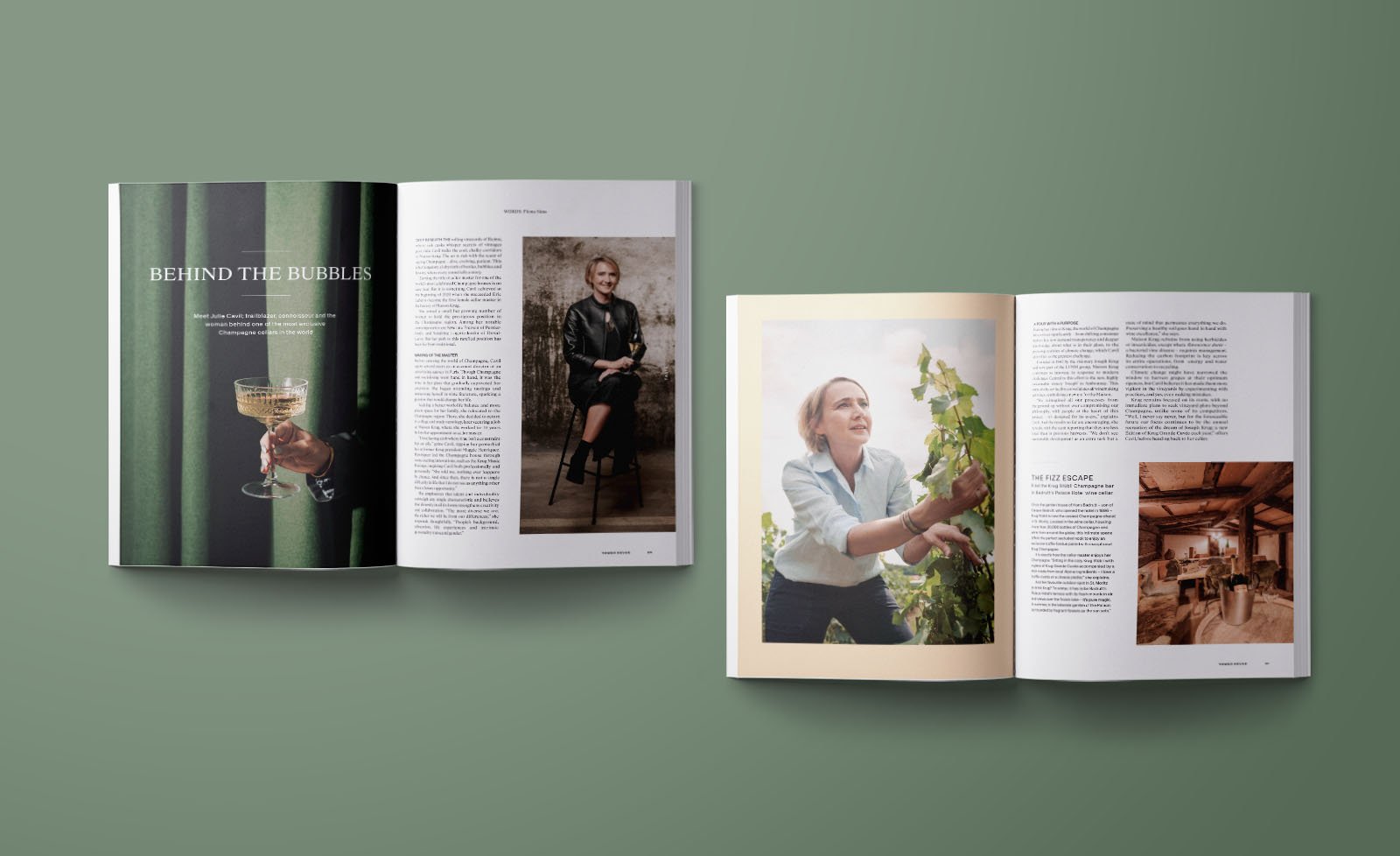
The unique perspective of a cellar master
Client: Badrutt’s Palace Hotel, St. Moritz
Article title: Behind the bubbles
The goal: To use Tower Revue magazine to spotlight Badrutt’s Palace Hotel’s authority in wine and Champagne – specifically its exceptional cellar and the Krug Stübli – by telling a human story that brings the Palace’s behind-the-scenes curation, taste and guest experience to life.
The story: At the centre was Julie Cavil – cellar master at Maison Krug and the first woman to hold the role in the house’s history. What made it a strong story was not just the prestige of her title, but the route she took to get there: a former advertising account director who changed direction, studied oenology, then spent 13 years at Krug before taking the top job. The narrative widened beyond biography into the pressures facing Champagne now – changing expectations, climate change and the need to innovate without losing a house’s essence. Crucially for Tower Revue, her world also served as a lens on the Palace’s own Champagne culture: the piece anchored Krug within the context of the hotel’s cellar and Krug Stübli, connecting the character story to a very real on-property experience.
Commercial angle: It worked because it drove on-property conversion. Tower Revue reaches guests while they are already at the Palace and turns the hotel’s cellar credentials into a clear next step: explore the Krug Stübli, book a cellar-led moment, and trade up into a higher-value wine experience. The commercial win is tangible but defensible, stimulating in-stay discovery and premium F&B spend.
Read more about our partnership with Badrutt’s Palace Hotel on their premium print and digital strategy.
What is a story?
This is where a lot of marketers get stuck.
A story is not just something with a beginning, middle and end – plenty of dreadful presentations and rambling case studies have those, but that doesn't make them stories.
Broadly speaking, a story has these elements:
- The status quo – What is normal before anything changes?
- The problem – What disrupts that normality and creates tension?
- The quest – What does the protagonist now need to do?
- Obstacles and surprises – What gets in the way? What makes progress difficult?
- The critical choice – What meaningful decision has to be made under pressure?
- The climax – Where does the main conflict reach its highest point?
- The outcome – What changed? What did it cost? Why did it matter?
You don’t always need every one of these in full, but the mechanics matter because they’re what make a story work.
- Character gives us someone to care about.
- Tension gives us a reason to keep following.
- A quest gives us momentum.
- Obstacles create difficulty and involvement.
- A critical choice makes the story active rather than descriptive.
- The outcome shows us what changed and why it mattered.
This is why stories are memorable and resonant in a way that product features, propositions and even advice often are not. A list of features tells me what something does. A story helps me understand what it means.
 Why humans matter
The phrase ‘human-first storytelling’ can sound vague, but it points to something very clear: stories work because they are about people and this remains true in B2B and other sectors where people assume story has no place. The character might be a customer, a founder, a member, a guest, a buyer, a patient, a team or simply the person inside the business trying to solve a problem, but there is still a person at the centre of the ‘thing’.
And characters are what drive empathy.
That’s why use cases are so often more compelling than feature lists. It's why case studies are stronger when they centre on an actual person with a genuine challenge rather than becoming a sanitised before-and-after. It is also why storytelling is so powerful in charity marketing. Charities often understand this better than brands do, because they do not lead with abstraction, instead they show a person, a problem, a struggle, a turning point and the difference support made.
These stories work because they are memorable and moving. They are human, and humans respond to stories.
Building bikes with hard-to-source parts
Client: Harley-Davidson/Harley Owners Group
Article title: Built from Scrap, Driven by Soul
The goal: To tell a story that felt unexpected, specific and deeply human – one that would widen readers’ sense of what motorcycle culture can look like and show how passion survives even in difficult conditions.
The story: At the centre was a motorcycle builder and customiser in Libya, trying to pursue his craft in conditions that made everything harder. What made the story so distinctive was the challenge of getting parts into the country just to keep bikes running. That gave the piece real tension and made it about more than motorcycles. It became a story about resourcefulness, identity and finding ways to keep doing what you love when the odds are against you.
Commercial angle: It worked because it strengthened the value of the magazine itself. A genuinely gripping story increases time spent, repeat readership and the sense that the publication is worth keeping – which, in member-led brands, supports retention and renewals. It also widens what the brand can credibly stand for, giving the community something richer to talk about and making the overall content proposition more attractive to partners and advertisers, without needing click metrics to prove it.
Read more about our work with the Harley Owners Group on community and content strategy.

Why stories drive action
This is the part that matters commercially.
We often talk about storytelling as though its job is simply to make content more engaging, and while that is true as far as it goes, it also undersells what story can do.
Stories do not just create engagement, they create movement.
They help people understand what is happening and why, see themselves in the situation, grasp what is at stake, feel the problem as something real and imagine a different future. That is what moves someone from passive awareness to active response.
This is why stories are so useful in high-consideration sectors, premium sectors and relationship-led sectors, because when you are asking someone not simply to notice you but to trust you, choose you, spend with you, advocate for you or back you, information on its own is rarely enough. You need something that helps them understand the value and feel the significance of it.
...and commercially
Commercially, stories do several jobs at once. They improve memorability because people remember movement, tension and change better than they remember generic claims. They build trust because specificity is more credible than polished vagueness.
They support premium differentiation because they show judgement, care and emotional intelligence rather than just listing features or banging on about value. And they improve conversion confidence because they help people picture what happens next – what the process looks like, what changes, what kind of experience they will have and why it will matter.
That becomes especially important when the thing being sold is complex, high-value or personal, because a strong story reduces uncertainty. It helps someone think, “Yes, I can see how this works. I can see how you solve problems. I can see what working with you would feel like.” That is commercial value, and it is doing the work of brand building, sales enablement and trust-building at the same time.
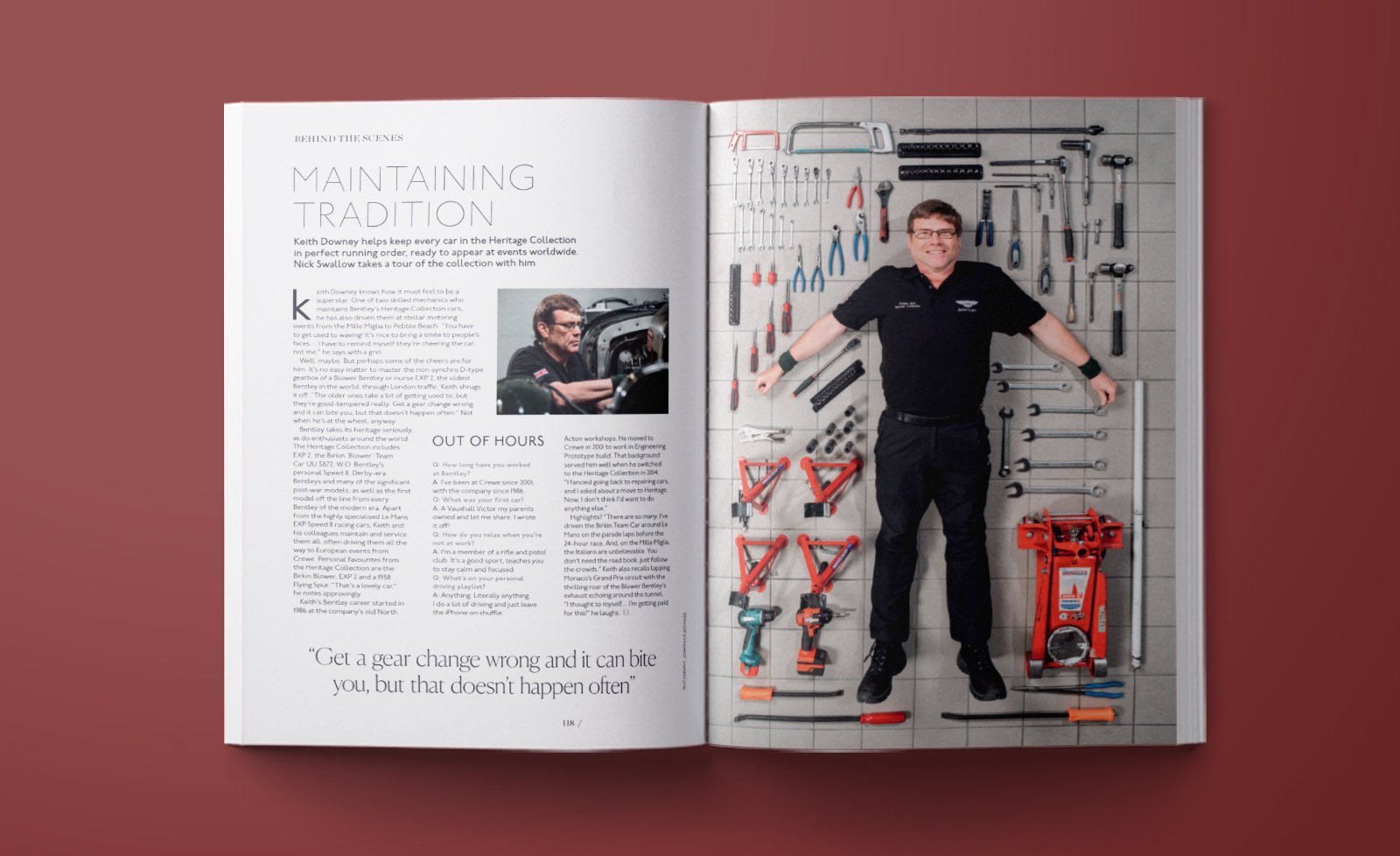
Craftsmanship you can see: the people behind the cars
Client: Bentley Motors
Article title: Behind the Scenes series (Bentley Magazine)
The goal: To make Bentley’s craftsmanship and provenance feel real and specific by showing the human expertise inside the Crewe factory – the precision, patience and specialist knowledge that sit behind a hand-built car. This regular feature appeared in each issue of the magazine and was designed to show what makes a Bentley stand out as a hand-crafted luxury vehicle, giving readers enough detail to picture the work, the people and the care that justifies a very high-value, highly personalised product.
The story: Instead of treating the factory as a backdrop, the series made the “lesser-known heroes” the main characters. You meet Jon O’Driscoll, an 18-year Bentley veteran who now guides visitors through CW1 House, the Lineage Museum and the production site, tailoring each tour to what the guest wants to see; Hazel Teasdale, an environmental engineer helping deliver Beyond100 and reimagine Crewe as a ‘Dream Factory’; and Steve Ward, a whole-vehicle reliability engineer who takes pre-production cars to extremes – from the Arctic Circle at minus 30°C to desert roads at 50°C – hunting faults so the finished Bentley feels effortless. The writing stays human and specific, and the bespoke photography makes the craft feel contemporary rather than museum-like: proof that these cars are made by people with obsessive standards, not by anonymous process.
Commercial angle: It worked because it turns provenance into decision confidence. In a high-value, highly personalised purchase, prospects are not just buying a car – they are buying trust in the people and standards behind it. By showing the hidden expertise behind every vehicle the series makes ‘hand-built in Crewe’ feel verifiable, reducing perceived risk, supporting premium pricing and giving retailers a shareable story asset that helps a buyer think: ‘I can see how this is made, and I can see what owning one would feel like.’
Read more about the exclusive print and digital content we produce in partnership with Bentley Motors.
Why so much brand content feels flat
A lot of brand content is not failing because it is badly written or badly designed.
It is failing because it is structurally flat.
There is no character, no real tension, no stakes, no movement and no sense that anything is changing or that anything matters. The content may be polished, but it doesn’t create involvement.
Customers at first contact almost certainly don’t care about your product – they will, once they understand the context, the problem, the human relevance and the change your product or service makes possible in their lives.
The irony is that most businesses are full of stories: customer stories, founder stories, team stories, process stories, failure stories and stories about difficult decisions, hard briefs, unexpected obstacles and better outcomes.
But instead of telling those stories, they flatten them into claims.
Inside a luxury brand’s impact report (and why it reads like a story)
Client: Bentley Motors
Article title: Bentley Environmental Foundation – Impact Report (1st edition)
The goal: To communicate credible environmental impact to every audience at once – customers, partners, media, employees and communities – by turning ESG reporting into human-first storytelling. The report needed to prove the Foundation’s substance (not just intent), show what genuine impact looks like, and strengthen Bentley’s positioning as a modern luxury brand whose responsibility is visible in action.
The story: Instead of leading with graphs, the report leads with people, place and change. It frames the Foundation’s first two years as a global, partner-led effort – supporting 18 projects across 14 countries and reaching 636,000+ beneficiaries through 1,600+ activities – then drops into specific, vivid narratives that make the impact legible. You meet coastal communities restoring mangroves in Kenya, learn how scientific expeditions helped secure protected ocean areas in the Dominican Republic, and follow local regeneration work close to Bentley’s home in Crewe. The numbers are there, but the stories make them mean something.
Commercial angle: This is reputation and risk-management content that also supports growth. For consumers, it strengthens brand preference by showing a form of luxury that is compatible with responsibility. For B2B audiences (partners, investors, talent and regulators), it functions as proof: clear pillars, credible governance and evidence of delivery – the kind of clarity that reduces scepticism and increases confidence to collaborate. And because it is genuinely readable, it travels further than a standard report: it earns attention, press pickup and internal engagement, helping Bentley turn sustainability from a compliance topic into a story-led brand asset.
Read more about our work creating highly visual, fully interactive premium brochures for Bentley Motors.
Why this matters more in the AI era
AI can produce endless competent copy, and that’s useful, but competence is not the same as persuasion. As content gets easier to make, the value shifts to the things that are harder to fake: judgement, empathy, tone, editorial discipline, specificity and the ability to shape a story with actual tension and meaning.
That’s why human-first storytelling becomes more valuable, not less, in an AI-saturated market that is flooded with content that’s technically fine but emotionally weightless. This content often imitates the shape of thought but not the pressure of it; that sounds right until you realise that nothing is really at stake and no one is really there.
People will still seek out quality content – they do not need endlessly new, strange or performative formats nearly as much as they need work that is simply good and interesting.
So no, the answer is not to produce more and more of the same because the tools make that easier. The opportunity is to produce better work that has a strong structure, brings careful judgement and balance, presents a point of view and has enough human texture to actually engage someone.
A lifetime in racing, and what’s changed
Client: Porsche Club GB
Article title: Wild’s About
The goal: To tell a story in Porsche Post magazine that felt rooted in real life experience, not just brand heritage and in doing so strengthen the commercial health of a member magazine. The piece was designed to bring Porsche racing culture to life through someone who had actually lived it while reinforcing the magazine itself as a valued membership benefit that supports retention, renewals and advertiser confidence.
The story: At the centre of it was Mike Wilds, a former Formula 1 driver now in his 70s, looking back on a lifetime in racing. What made it interesting was not just who he was, but the contrast he could draw – between old and new cars, old and new skills, old and new kinds of driving. There is something quietly powerful in someone like that reflecting on what has changed, what has been lost and what only a few people can still really do.
Commercial angle: It worked because it made the brand heritage feel earned rather than asserted and increased the perceived value of the magazine itself. In a membership model, that translates commercially into stronger loyalty, renewals and a more saleable advertising environment: the more readers genuinely read and keep an issue, the more confident partners feel about investing in it. That is exactly the logic Porsche Post has been built on over time. This individual story is one of the building blocks that makes that wider commercial model work.
Read more about the multimedia content we create for Porsche Club GB.
What brands should ask instead
So what does this mean in practice? Brands need to stop asking only, ‘What do we need to say?’ And start asking questions like:
- Who is this really about?
- What is normal at the start?
- What has disrupted that normality?
- What does the person want?
- What is getting in the way?
- What decision matters?
- What is at stake?
- What changed in the end?
- Why should anyone care?
Those are story questions. They’re also useful strategic questions, content questions, sales questions and case study questions. And this is not just about big campaigns or glossy brand films. Stories live everywhere:
- Pitches
- Reports
- Meetings
- Mission statements
- About us content
- Articles
- Guides
- Emails
- Interviews
- Product pages
Anywhere you need someone not just to receive information, but to understand it, remember it and do something with it.
The commercial case
You could argue that human-first storytelling is simply a nicer, warmer or more authentic way for brands to communicate, and that is fair enough as far as it goes, but it is not really the point. Its real value is commercial. Storytelling is a mechanism for attention, empathy, understanding, memory and action because it helps people understand why something matters, trust what they are hearing, imagine a different future and ultimately decide.
Storytelling is a mechanism for attention, empathy, understanding, memory and action.
And when content becomes easier to produce at scale, those qualities become more valuable, not less. That’s why human-first storytelling brings brands a competitive advantage. The brands that win will not be the ones producing the most content, but the ones using the mechanics of story with the most intelligence and discipline.
If you need content that doesn’t just describe what you do but helps people understand it, trust it and act on it, contact us.

Related articles

Read more insightful articles
See more from the blog
When every yacht is different, how do you communicate what makes your brand distinctive?

Beyond the click – are we measuring email too narrowly?

Dialogue shortlisted for 10 International Content Marketing Awards 2026

Tactical gravity: why automotive launches can drift away from strategy
Proud to be a winner of industry awards, recognised as content marketing experts in print and digital media.