-
Content Marketing For
Luxury Audiences >

-
Trusted By
Leading Automotive Brands >

-
Experts In
Travel & Hospitality >

Print is now widely described as a luxury medium. But it wasn’t always the case. This article explains how digital’s arrival accidentally conferred luxury status on print by clearing out the mass-market advertisers who once filled the same pages as Rolex and The Ritz – and why that structural shift, compounded now by AI saturation and a growing appetite for human meaning over algorithmic content, makes print a more strategically powerful tool for luxury brands than at any point in the last thirty years.
How did print become luxury?
Thirty years ago, print wasn’t a luxury medium – it was just media. It had already learned to share the room with radio and then television, and it had survived both. Brands used all three fairly smoothly. The Ritz and a package holiday company still ran ads in the same Sunday supplement, Rolex and a high street jeweller still sat side by side in the same magazine. Print wasn’t a choice; it was just infrastructure – and so it was ubiquitous (which is another word for ordinary).
What’s more, radio and TV had each taken something from print without fundamentally changing its character. Radio took mass-reach audio. Television took the emotional, moving-image budget. But print remained, democratically mixed – everything from flyers full of offers in supermarkets to high-end fashion magazines, from local free papers to company branded filofaxes. Disruptions had squeezed print without filtering it. Only into the mid ‘00s did print decline as a marketing medium (at the same time as the newsstand).
So, when we talk about print as a ‘premium’ or ‘luxury’ channel, it’s worth pausing on how that actually happened, because print didn’t become luxury by changing or improving. It had survived bigger cultural shifts than digital with its mass-market character entirely intact. What changed wasn’t print. It was the specific economics of what came next – and those economics did something to print that radio and television never had.
What digital actually did
When digital arrived, the conventional story is that it slowly killed print. And in volume terms, it did. In commercial print, circulations fell. Ad revenues shifted. Titles closed. And the content marketing sector exploded as brands embraced digital channels to access audiences.
But look more carefully at which brands left print behind and a different pattern emerges.
Mass-market advertisers fled earliest and fastest and many established newsstand titles declined through the ‘00s and ‘10s. Digital’s economics suited advertisers perfectly: cheap to place, easy to measure, endlessly scalable. For a brand whose goal is reach – getting in front of as many people as possible, as cheaply as possible – the logic was irresistible.
Premium and luxury brands were slower to follow. Some stayed in print through inertia. Others because their audiences were slower to shift. But the net effect was a filtering process that nobody had designed. As the volume brands left, the average prestige of what remained in print quietly rose. The medium was being repositioned upmarket not by any editorial decision or strategic pivot, but simply by who was leaving.
This matters because it means print’s luxury status isn’t intrinsic. It’s structural and relative – a product of market dynamics. And that makes it considerably more durable than if it were simply a matter of taste.
The accidental scarcity argument
There’s a broader pattern here that print fits into precisely. Think about vinyl records. They didn’t get better when streaming arrived – if anything, they got more inconvenient, more expensive and harder to find. But that inconvenience became the point. Owning vinyl began to signal something: intentionality, taste, a willingness to slow down. Rarity conferred status.
The same logic applies to film photography, to handwritten correspondence, to analogue watches in an age of smartphones that tell the time more accurately. In each case, a functional technology was abandoned for something cheaper and faster, and the abandonment itself transformed what remained. The mass market moved on, and the medium moved upmarket.
Print followed exactly the same path. The luxury brands didn’t make print special. Everyone who stopped using print did.
What the smartest publishers now understand
The most telling evidence for this shift isn’t from brands – it’s from publishers themselves. Condé Nast’s decision to move Vogue in the US to eight issues a year (down from 10), printed on heavier stock, is not a retreat. It’s an application of luxury brand logic to a media product. Fewer drops. Higher quality. More event-like. Collectible from the moment it arrives.
Mark Guiducci, Vogue’s global editorial director at Vanity Fair, put it plainly: print issues “no longer move into the collectible category – they start there.” It’s a product strategy borrowed wholesale from the luxury goods playbook – the same thinking that makes a limited-edition release more desirable than a standard one, and a seasonal collection more anticipated than a permanent line.
It’s a shift that hasn’t been lost on the fashion houses either. Chanel, Bottega Veneta and Saint Laurent have each continued investing heavily in physical editorial experiences – not as campaign collateral, but as world-building. Their print presence doesn’t announce a product, it constructs an environment, a set of values, a cultural position that the product then inhabits. That’s a fundamentally different use of the medium than a double-page spread in a mass-circulation title ever was.
Global media business publication Flashes and Flames, exploring what it calls the ‘new opportunities in print magazines’, frames this shift precisely: “Print magazines have moved from mass media to luxury media, and the opportunity for publishers rests on their ability to tap into communities of interest that are committed to a cause, a lifestyle, a pastime. Print creates the space for long-form content that can properly explore what they care about most.”
The same logic plays out at a smaller scale in luxury jewellery. Independent brands like London-based Lylie Jewellery, founded in 2017, have introduced print catalogues not because they’re trying to reach more people, but because they’re trying to reach the right people in a more deliberate way. Lylie’s founder reduced her digital marketing spend to £500 a month, replacing it with a 50-60 page printed catalogue that includes an exclusive discount code so its impact can be directly tracked. “It is a significant investment and a deliberate strategic decision that we see a significant return on,” she says. Another example in this sector is the fine jewellery house Robinson Pelham, which has distributed its annual catalogue to clients every November for 25 years with huge success. So much so that clients collect them.
These aren’t heritage brands reflexively defending old habits. They’re brands making a clear-eyed calculation that a physical, considered, finite object does something for their positioning that a targeted digital ad – however precisely served – simply can’t.
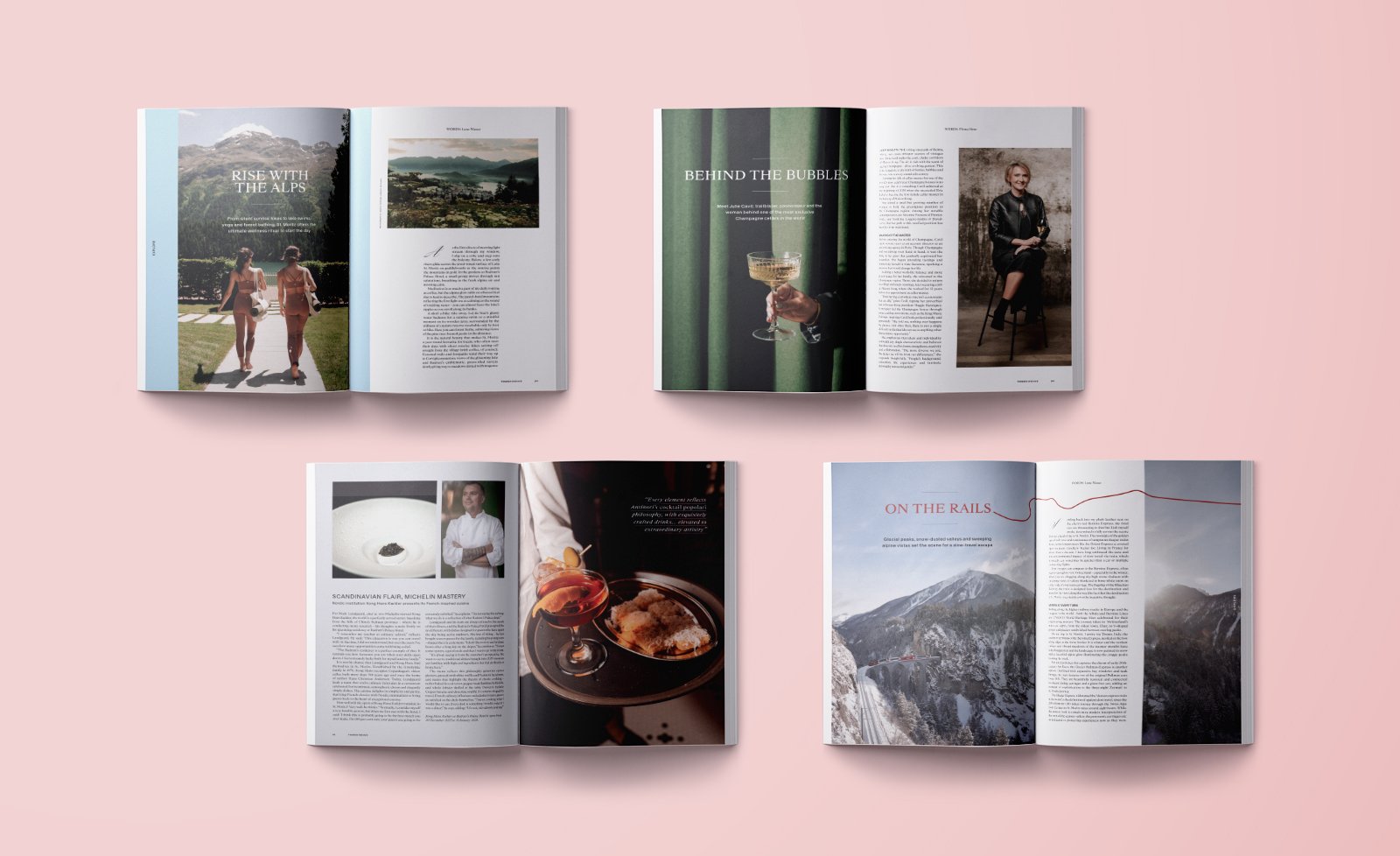
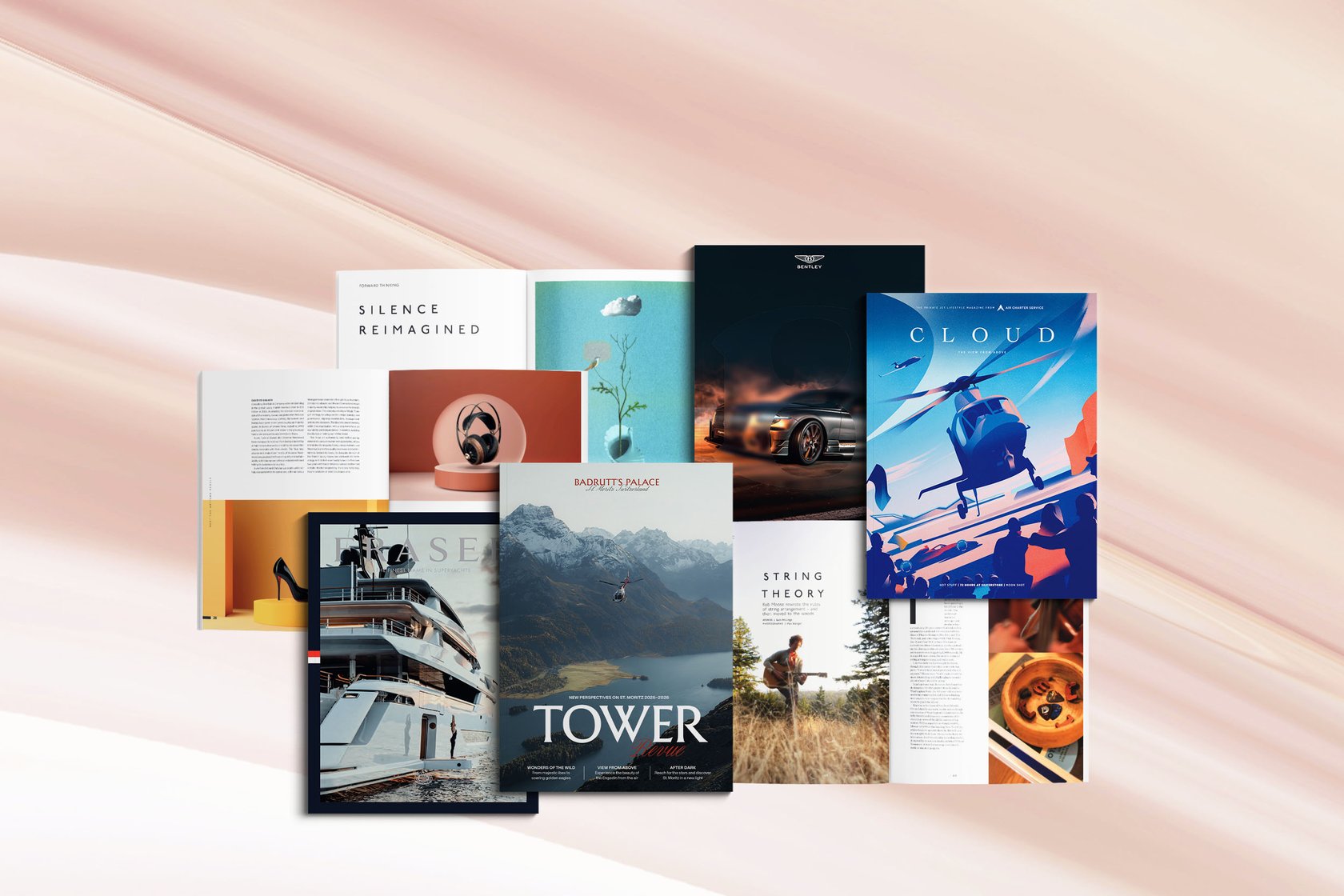
The same principle applies in luxury hospitality, where print can extend the guest experience and deepen emotional connection. For Badrutt’s Palace Hotel, Dialogue produces Tower Revue, a beautifully crafted annual magazine that allows the St. Moritz hotel to extend its signature elegance into the homes of its most loyal guests. Combining high-end lifestyle journalism, bespoke imagery and rich storytelling, the magazine reinforces Badrutt’s Palace’s position as a cultural icon. You can read more about how Dialogue collaborates with Badrutt’s Palace Hotel to capture the stories that resonate with guests.
Discover more in our article on the power of print in the luxury hospitality market, which explores further how print signals value: “Luxury is no longer defined by abundance and instead it’s defined by attention. Every detail, from embroidered linens to a handwritten note, signals that a guest is valued. Print works the same way.”
And the numbers across the whole print publishing space support the instinct that print is the best way to engage with an ultra-high-net-worth audience. The average magazine reader spends 41 minutes with an issue at a sitting – not skimming, not multitasking, but giving their full attention to a single publication. In an era when digital content is measured in seconds of engagement, that kind of dwell time is a different proposition entirely. It’s also why younger affluent audiences – the next generation of HNWI and UHNWI consumers – are increasingly drawn to print, vinyl, film photography and physical books as deliberate antidotes to digital overload. For this audience, choosing print goes beyond nostalgia and is instead a statement about how they want to spend their attention.
We’ve explored this dynamic before in our article on the power of print magazines for engaging with an audience.
There’s a further signal in what luxury brands are doing to print itself. Spot foiling, special laminates, heavyweight stocks, tactile finishes – investment in production values has increased markedly as the strategic intent behind print has sharpened. This isn’t decoration. It’s the physical object making an argument: that this brand has something worth holding onto, worth handling carefully, worth keeping. The medium that became luxury by accident is now being deliberately pushed further upmarket by the brands that understand why it works.
Explore some of the impactful print publications Dialogue has produced for luxury brands in the automotive, travel and hospitality sectors.
The AI accelerant
There is a newer dimension to this that has arrived quickly and hasn’t yet been fully absorbed by the marketing industry.
We are now producing more content than at any point in human history. AI has made content generation cheap and fast, and the result is a digital environment so saturated with material that provenance – knowing where something came from, who made it and why – has become genuinely uncertain. Feeds are full of content that looks considered but wasn’t. Articles that appear researched but weren’t. Images that seem original but aren’t.
A printed object can’t be faked in the same way. Once something is on paper, the choices are fixed. The editorial decisions are visible. The investment – in time, in craft, in production – is self-evident in a way that a well-designed website simply isn’t. For a luxury audience that is fundamentally buying authenticity, that distinction is becoming more meaningful, not less.
In a world of infinite, frictionless, algorithmically generated content, scarcity of editorial intent is itself becoming a luxury signal.
What this means for luxury brands
The most important strategic reframe here is this: the brands succeeding with print are no longer treating it as a distribution channel. They’re treating it as positioning infrastructure – a way of constructing and communicating brand identity that operates at a different depth than campaign content. The question isn’t ‘how many people will see this?’ It’s ‘what does this say about who we are?’ That shift – from reach to trust, from impressions to authority – is what separates a print strategy from a print habit.
Dialogue’s Head of Content Cathy Wood explains that the mechanism is self-reinforcing.
“Luxury brands should be rethinking the questions they are asking around print. It’s not ‘should we still be in print?’ as if print needs defending against the encroachments of modernity. It’s ‘do we understand why print works now in a way it didn’t thirty years ago – and are we using it accordingly?’”
As digital channels grow noisier and less trusted, premium brands are increasingly finding that credibility and depth outperform raw impressions. Reach was the logic of mass media. Trust is the logic of luxury. And of the available channels, print – finite, considered, physically present – is the one that signals trust most naturally.
Cathy adds: “We know through our own experience with premium and luxury brands in the automotive, travel and hospitality sectors that luxury brands enjoy some of the most passionate and engaged audiences, who are keen to receive printed magazines as a reward for loyalty and even display them as a signal of wealth and success. And by taking it one step further with a cover price, luxury brands can tap into this committed audience and leverage brand legacy.
“One area particularly worth considering is the brand book – a hardback luxury annual publication that will absolutely be snapped for Instagram coverage. Brands can explore their heritage, products, passion points, future strategy and more in beautifully designed and bound publications that are less magazine and more a piece of art. Think boxed, bound, foiled, gold-edged and weighty. Beautiful. And far more long-lasting than a quick ‘blink-and-you'll-miss-it’ social media post or brand ad. This sort of product costs to print, sure, but it also offers such a long lifecycle for brand awareness that the value becomes more obvious.”
There’s a meaningful difference between being in print out of habit and being in print deliberately. The brands that are getting the most from it aren’t the ones with the longest print heritage. They’re the ones that understand the underlying logic: that print’s power in luxury comes not from what it always was, but from what it has become – a format defined by its own restraint, its finitude and its resistance to the conditions that define everything else competing for a luxury audience’s attention.
Print became luxury by accident. Using it well is anything but.
For luxury brands looking to make print work harder, that means having a strategy that is as considered as the publication itself. At Dialogue, we help brands shape print magazines that go beyond merely looking beautiful – they build affinity, reward loyalty and strengthen positioning in markets where audience expectations are high. You can find out more about our print magazine strategy and production expertise and how we support premium and luxury brands.

Resources
Print issues no longer move into the collectible category – Mark Guiducci
New opportunities in print magazines – Flashes and Flames
Print proves its staying power for jewellery branding – Financial Times
Related articles

Read more insightful articles
See more from the blog Content
When every yacht is different, how do you communicate what makes your brand distinctive?
 Content
Beyond the click – are we measuring email too narrowly?
 Content
Dialogue shortlisted for 10 International Content Marketing Awards 2026
 Automotive
Tactical gravity: why automotive launches can drift away from strategy
Proud to be a winner of industry awards, recognised as content marketing experts in print and digital media.